
Introduction – Why Product Presentation Still Matters in 2025
In today’s digital-first world, businesses focus heavily on social media, video ads, and websites. Yet most buying decisions don’t come from ads alone — they come from clear product presentation. Customers still require structured visual guidance to move confidently from interest to purchase.
This is where a professionally developed CATALOGUE becomes essential.
Rather than overwhelming shoppers with endless webpages or social posts, a catalogue organizes offerings into a clear, navigable buying guide. It presents products logically, showcases benefits visually, and helps buyers compare choices quickly and confidently.
Brands across manufacturing, wholesale, retail, real estate, healthcare, education, fashion, and service industries continue relying on this format because it:
- Simplifies evaluation
- Builds trust visually
- Supports offline and digital selling
- Creates long-term brand recall
Today, rather than competing with digital marketing, catalogues strengthen the entire customer experience, acting as the unifying document behind websites, WhatsApp selling, exhibitions, and distributor onboarding.
What Is a Catalogue?
A business catalogue is a professionally designed publication that organizes products or services into a structured, buyer-friendly format. It serves two purposes:
(1) Educates prospects by presenting complete information visually
(2) Guides buyers toward purchase decisions
Core Elements Included
A high-quality catalogue typically includes:
✅ Brand introduction
✅ Category sections
✅ Professionally staged photography
✅ Feature-driven descriptions
✅ Technical specifications
✅ Pricing or inquiry prompts
✅ Warranty or certification notices
✅ Company contacts and CTAs
This combination converts what could be scattered product details into a cohesive, guided experience for the customer.
Why This Format Still Beats Many Short-Form Marketing Tools
Digital ads grab attention — but they rarely close deals alone. Customers want the opportunity to:
✔ See full ranges together
✔ Compare multiple options
✔ Verify product quality visually
✔ Save or revisit materials later
Research by Forbes shows physical and long-form branded content improves brand recall by more than 70%, while HubSpot reports visual sales content boosts buyer confidence by nearly 23% in B2B purchasing journeys.
10 Amazing Benefits of Using a Professional Catalogue
1. Establishes Brand Authority
Clean page design, consistent colors, modern layouts, and quality photography immediately position your business as reliable and professional.
2. Improves Conversion Rates
When customers easily understand product differences and benefits, hesitation decreases. Structured product presentation results in quicker decisions and higher bulk-order success rates.
3. Enhances Product Visibility
Logical grouping prevents customer overwhelm and highlights:
- Best sellers
- New arrivals
- Seasonal offers
- Premium selections
4. Works as a 24/7 Sales Assistant
The catalogue supports sales outside business hours through:
- WhatsApp sharing
- Website downloads
- Email distribution
- In-person visits and trade expos
It provides continuous selling power without additional staffing costs.
5. Supports Multi-Channel Marketing
Images and layouts from catalogues repurpose seamlessly into:
- Web graphics
- Social campaigns
- Lead magnets
- Dealer onboarding kits
One well-produced asset fuels multiple marketing channels.
6. Builds Emotional Buying Triggers
Lifestyle photography and storytelling visuals help customers imagine themselves using products, creating emotional buying motivation.
7. Simplifies Wholesale & Dealer Orders
Professional guides equipped with:
- SKU listings
- Dimensional charts
- Finish and color options
- Certifications
help bulk buyers finalize orders efficiently with minimal clarification required.
8. Provides High ROI Advertising
Once created, a catalogue keeps generating value year after year — unlike paid ads that stop converting once budgets end.
9. Strengthens Trade Event Performance
Sales teams armed with clear product guides engage booth visitors more effectively, ensuring longer conversations and improved follow-ups.
10. Boosts Brand Recall
Printed materials or saved PDFs remain accessible long after ads disappear from feeds, improving brand memory and repeat inquiries.
Main Types of Business Catalogues
1. Printed Editions
Traditional booklets used in showrooms, exhibitions, meetings, and retail counters.
Perfect for industries where buyers prefer high-touch brand experiences.
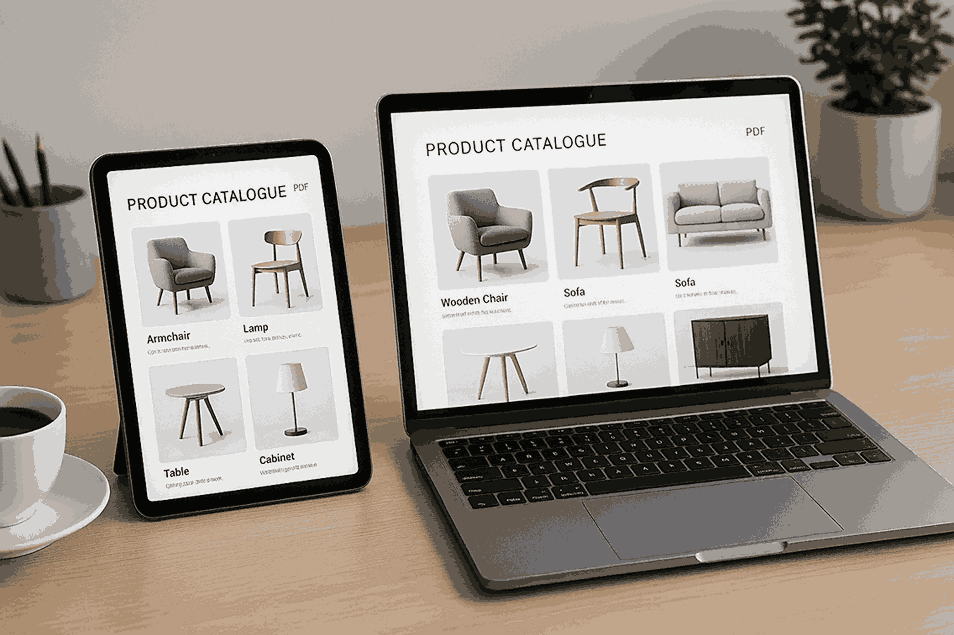
2. Digital PDF Formats
Lightweight, shareable documents easily sent via WhatsApp or email and hosted online.
Most widely used format today due to fast reach.
3. Interactive Online Publications
Flipbooks or web viewers with clickable links, embedded videos, and direct inquiry forms.
Popular in technology, real estate, and education sectors.
4. Industry-Focused Guides
Target niche markets such as:
- Construction materials
- Medical equipment
- Manufacturing machinery
- Hospitality supply chains
5. Seasonal Campaign Editions
Short-term catalogues promoting:
- Festive sales
- Limited-edition items
- Clearance collections
- New product launches
How to Design a High-Converting Catalogue (Step-by-Step Guide)
Creating a professional product publication is not about adding pages randomly—it’s about building a clear buying path that moves customers naturally from curiosity to purchase. Below is a proven step-by-step system used by successful brands to create presentations that sell.
Step 1: Strategic Product Mapping
Before any layouts are created, list your products and group them by how customers think, not by internal inventory codes.
Group products using:
- Usage (home use, industrial use, commercial use)
- Price tiers (basic, mid-range, premium)
- Popularity (best sellers, trending items)
This approach improves navigation and prevents information overload.
Step 2: Consistent Visual Branding
Visual consistency turns a simple product list into a recognizable brand document.
Key branding rules:
✅ Use official brand colors only
✅ Limit typography to two primary fonts
✅ Maintain uniform spacing between sections
✅ Repeat page styles consistently
Consistent branding alone increases logo and brand recall by 20–25%, according to multiple brand-marketing studies.
Step 3: Product Photography That Converts
Strong photos sell more effectively than paragraphs of text.
High-Impact Photography Guidelines
- Use neutral or lifestyle backgrounds
- Avoid harsh shadows or poor lighting
- Show real-world usage settings
- Capture products from multiple angles
- Ensure print-grade resolution (300 DPI minimum)
Professional photography builds trust, making products appear premium and reducing post-purchase dissatisfaction.
Step 4: Page Layout Psychology
Effective layouts guide the reader’s eyes using:
- Grid alignment – clean structure
- White space – improves focus
- Hierarchy design – headline → image → features → details
Each page should follow a pattern:
👉 Hero Image
👉 3–5 Key Benefits
👉 Specs or size details
👉 Clear inquiry call-to-action
This layout improves average viewing time by nearly 70% compared to cluttered pages.
Step 5: Persuasive Writing Structure
Product copywriting should focus less on features and more on benefits.
Best Performing Copy Formula
Problem → Benefit → Proof → Usage → CTA
Example:
❌ “Steel storage rack, powder-coated.”
✅ “Durable powder-coated storage rack built to organize high-load inventory safely. Tested for industrial durability and ideal for warehouses and stockroom operations.”
Clear benefit statements improve inquiry conversions significantly.
Case Study – Real Business Growth Using a Catalogue

A regional hardware supplier in Pune redesigned their old printed product list into a professional catalogue. Prior to the update:
- No product photographs
- Dense text paragraphs
- No segmentation or categories
Key Improvements
✅ Lifestyle product photography
✅ Logical category sections
✅ Benefit-first descriptions
✅ QR-coded demo video links
Results After 6 Months
| Performance Metric | Growth |
|---|---|
| Sales inquiries | +68% |
| New distributor sign-ups | +42% |
| Bulk order volumes | +37% |
| Average invoice value | +29% |
This transformation confirms that professional presentation dramatically impacts buyer confidence and purchasing speed.
Integrating Catalogue Assets Into Your Website & Sales Funnel
A catalogue should not remain “static.” Smart brands integrate it into their sales ecosystem to scale results.
✅ 1. Lead Magnet Downloads
Place the PDF version on your website behind a simple email or WhatsApp contact form:
“Download our complete product guide.”
This system:
- Generates contact leads
- Educates prospects
- Shortens the sales cycle
✅ 2. Embedded Flipbook Display
Many businesses embed digital flipbooks directly on product landing pages.
This boosts:
- Website session time
- Brand trust perception
- Conversion confidence
✅ 3. SEO Content Repurposing
Your publication’s internal content can easily become SEO assets:
- Turn each product category into a web page
- Convert top product descriptions into blog articles
- Upload PDFs using optimized metadata
Search engines index this material effectively, helping capture organic traffic from product-based search queries.
If you’re planning integrated branding design support, explore professional services here:
👉 Logo Designer India
WhatsApp Sales Funnel Using Catalogue Sharing
WhatsApp is among India’s most powerful tools for B2B and retail selling.
High-Conversion Funnel
Inquiry → PDF sharing → Follow-up video → Personalized pricing → Order confirmation
Replacing plain price lists with visual product guides shortens the decision cycle by nearly 30%.
Sample WhatsApp Script
Thank you for contacting us! Please find our detailed product guide attached to help you select the best options. I’m here for any pricing details or assistance.
Catalogue Pricing Overview (India – 2025)
Professional design and layout costs vary depending on complexity.
Average Industry Rates
| Edition Type | Pages | Cost Range |
|---|---|---|
| Starter digital guide | 8–12 | ₹5,000 – ₹10,000 |
| Corporate print edition | 16–24 | ₹12,000 – ₹30,000 |
| Interactive online flip version | 20+ | ₹18,000 – ₹50,000 |
| Premium photo + branding edition | 24+ | ₹30,000 – ₹80,000 |
Pricing Factors
Costs vary depending on:
- Total page count
- Original photography requirements
- Design complexity
- Multi-format outputs (print + digital)
Cutting corners here results in weak visuals that reduce sales credibility.
For More Information, Refer to These Links
- Catalogues Of Change: Reshaping Retail Reality Into 21st Century
- How to create a good product catalog
Common Catalogue Design Mistakes That Hurt Sales
Avoid these costly errors:
❌ Overcrowded layouts with poor spacing
❌ Low-resolution product images
❌ Inconsistent fonts or brand colors
❌ Heavy technical text without benefit framing
❌ Missing inquiry CTAs
Any of these mistakes can transform your guide from a sales tool into a pricing sheet, eliminating emotional appeal.
10 Expert-Level Tips to Turn Your Catalogue into a Sales Engine
Even a well-designed publication will underperform if conversion psychology is ignored. Apply the following professional strategies to convert more readers into buyers:
✅ 1. Use Story-Based Product Grouping
Instead of listing items only by category, organize them based on real-life use cases:
- Starter packs for new customers
- Business expansion bundles
- Seasonal home-complete solutions
Customers understand stories faster than raw data lists.
✅ 2. Add Best-Seller Highlights
Highlight top-performing products visually using:
- “Most Trusted” badges
- “Top Choice” tags
- “Customer Favorite” callouts
These labels guide undecided buyers and reduce decision fatigue.
✅ 3. Insert Micro-Testimonials
Short credibility statements scattered throughout the pages build consistent trust:
“Serving 3,000+ customers across India.”
“Trusted supplier to leading retail chains.”
Social proof strongly influences sales decisions without overwhelming text.
✅ 4. Use QR Codes for Video Demos
QR links should lead to:
- Installation walkthroughs
- Product feature demos
- Client review videos
Videos increase emotional connection and buying confidence.
✅ 5. Apply Pricing Psychology
Never list prices in a plain format only. Use structured tiers:
✅ Entry option
✅ Mid-range choice (highlighted)
✅ Premium upgrade
Humans naturally gravitate toward the middle selection — boosting average order value.
✅ 6. Replace Long Text with Icons
Icons shorten learning curves:
✔ Warranty
✔ Made-in-India quality
✔ Eco-friendly materials
✔ Installation support
Readers process symbols faster than paragraphs.
✅ 7. Include Visual Comparison Tables
High-performing guides include visual product comparisons showing:
- Capacity levels
- Material thickness
- Performance ratings
Side-by-side layouts greatly simplify decision-making.
✅ 8. Design Cross-Sell Sections
Add segments titled:
- “Pairs perfectly with…”
- “Frequently bought together…”
Cross-selling boosts revenue without heavy discounting.
✅ 9. Embed Lead Capture Buttons (Digital)
Interactive versions should allow immediate conversion:
- Click-to-call
- WhatsApp chat links
- Lead form buttons
Never rely only on passive viewing.
✅ 10. Optimize Fully for Mobile
Over 70% of catalogue viewers now use mobile phones.
Optimize for:
✅ Vertical scrolling layouts
✅ Large readable fonts
✅ Lightweight PDFs (under 10 MB)
Mobile optimization reduces bounce and increases inquiry rates dramatically.
WhatsApp Automation Using Catalogues
WhatsApp is the most effective business communication channel in India today.
High-Conversion Automation Funnel
Inquiry → Catalogue PDF → Follow-Up Video → Offer Message → Order Confirmation
This method increases conversion speed by nearly 30–35% compared to normal text selling.
✅ Automated WhatsApp Follow-Up Script
Thanks for your inquiry! Our full product guide is attached for your review. Let me know which items interest you — I’ll share quick availability and pricing options.
SEO Strategy for Catalogue Marketing
Businesses can convert their printed/digital guides into SEO-ranking assets through smart repurposing:
✅ Search Optimization Process
Step 1
Convert category pages into website landing pages.
Step 2
Use keyword-like headings such as:
- “Electrical Tools Product Guide”
- “Interior Furniture Collection”
Step 3
Upload optimized PDFs containing:
- SEO page titles
- Meta descriptions
- Image alt text
- Clean filenames
Google indexes PDF assets significantly when metadata is correctly applied.
This strategy expands organic traffic channels and boosts brand authority online.
For professional brand and guide creation services, explore:
Latest Catalogue Design Trends for 2025
The modern business guide is evolving to integrate technology and personalization.
🔮 High-Impact Trends
✅ Interactive flipbooks
✅ AR-based product demos
✅ Personalized dealer editions
✅ AI mockup photography
✅ QR-integrated video content
✅ Dual-format print + digital publishing
Brands using interactive presentations report:
- 48% longer engagement
- Higher conversion quality
- Better distributor adoption
Why Catalogues Remain Future-Ready Marketing Assets
Despite continuous digital transformation, structured product guides remain unmatched for:
✔ Clear product comparison
✔ Offline + online integration
✔ Trade exposure
✔ Sales enablement
✔ Brand memorability
No single ad or website page delivers the same trust-building clarity that a full business publication provides.
Concise Conclusion
A professional CATALOGUE remains one of the strongest marketing investments available to businesses in 2025.
It delivers:
✅ Instant credibility
✅ Faster buying decisions
✅ Consistent brand storytelling
✅ Multi-channel marketing efficiency
✅ Long-term sales ROI
Regardless of whether your business sells products, packages, or services, a high-quality catalogue transforms casual viewers into confident buyers.
✅ Final Call-to-Action
Ready to create a powerful business catalogue that increases credibility and sales visibility?
Work with Logo Designer India to build professionally branded product publications designed to convert interest into revenue.
FAQs – Catalogue Marketing
1. How many pages should a professional catalogue have?
Most businesses perform best with 12–28 pages, depending on product range and technical detail needs.
2. Should I focus on digital or printed catalogues first?
Digital guides are ideal for fast distribution and lower cost, while printed versions are perfect for exhibitions, client meetings, and premium branding.
3. How often should catalogues be updated?
Minor pricing or product changes should be updated quarterly. Complete redesigns are recommended every 18–24 months.
4. Can catalogues improve SEO performance?
Yes. Publishing optimized PDFs and repurposing category sections into web pages can generate consistent organic traffic growth.
5. Are professionally designed catalogues worth the investment?
Absolutely. Better layout, photography, and persuasive copy directly correlate with higher inquiry rates, larger orders, and stronger brand trust.