
Introduction
In an age of digital scrolling and instant marketing, you might wonder if printed or digital catalogues still matter. The short answer is — absolutely yes. When executed properly, CATALOGUE DESIGN remains one of the most powerful tools to showcase products, tell brand stories, and directly drive purchasing decisions.
Think about the last time you browsed a professionally designed catalogue — either online or in print. The clean layouts, perfectly balanced images, clear descriptions, and strategic calls to action didn’t just look good — they built trust and inspired confidence. That emotional response is precisely what well-planned catalogue design achieves.
For brands in retail, manufacturing, hospitality, real estate, healthcare, and countless other industries, catalogues continue to play a vital role. Whether distributed physically at trade shows, mailed to customers, or delivered digitally via websites and WhatsApp, catalogues communicate credibility and professionalism at scale.
In this complete guide, you’ll learn:
- What makes effective CATALOGUE DESIGN work
- How to craft layouts that convert readers into buyers
- The role of typography, photography, and branding
- Common mistakes brands must avoid
- Latest design trends for 2025
By the end → you will know how to build catalogues that not only look great but also produce measurable business results.
What Is CATALOGUE DESIGN?
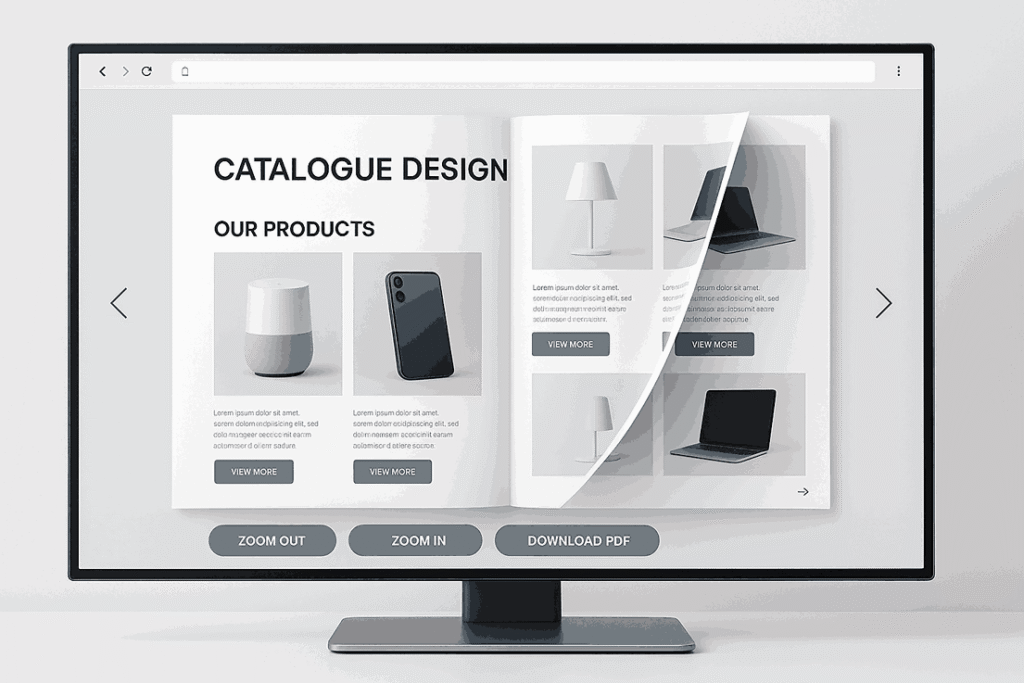
CATALOGUE DESIGN is the strategic process of organising products or services into a visually appealing and easy-to-navigate layout that informs, attracts, and persuades potential buyers.
A professionally designed catalogue combines:
- Graphic layout structure
- High-quality images
- Consistent brand styling
- Persuasive text descriptions
- Logical product grouping
Catalogues can be either:
✅ 1. Print Catalogues
Printed booklets or magazines used for:
- In-store browsing
- Trade shows
- Corporate presentations
- Direct mailing campaigns
✅ 2. Digital Catalogues
PDFs, flipbooks, or interactive web catalogues used for:
- Website downloads
- Mobile browsing
- WhatsApp sharing
- Email marketing campaigns
Modern CATALOGUE DESIGN ensures both formats work seamlessly together, offering consistent branding across platforms.
Why Is Professional CATALOGUE DESIGN So Important?
Your catalogue is essentially your portable showroom. For many businesses, it is often the first detailed product interaction potential buyers experience.
When design is done right, catalogues:
✅ Build trust
✅ Increase brand authority
✅ Improve reader engagement
✅ Shorten sales cycles
✅ Drive purchasing decisions
✅ Support your sales representatives
But poorly designed catalogues do the opposite:
❌ Confuse buyers
❌ Reduce credibility
❌ Overwhelm readers
❌ Lower product visibility
❌ Kill conversions
📍 Real-World Example
A Pune-based furniture brand struggled to close wholesale deals at exhibitions. Their old catalogue had crowded layouts, inconsistent fonts, and dull photography. After investing in professional CATALOGUE DESIGN, they:
- Organized products by category and size
- Standardized fonts and color styles
- Used lifestyle product photography
- Added clear pricing blocks and inquiry QR codes
Result:
They reported a 43% increase in confirmed dealer leads within 3 months and significantly shorter negotiation cycles.
Psychology Behind High-Converting Catalogues
Good catalogue design isn’t about artistic visuals alone — it’s rooted deeply in consumer psychology.
The buying brain responds to:
- Clarity: Easy scanning layouts reduce cognitive fatigue.
- ** Trust signals:** Clean branding increases confidence.
- Visual hierarchy: Highlighting “hero products” guides attention.
- Social proof: Certifications and testimonials build reassurance.
- Simplicity: Fewer distractions improve decision-making.
Key Psychological Principles Applied to CATALOGUE DESIGN
| Design Principle | Consumer Impact |
|---|---|
| White Space | Improves attention and readability |
| Visual Hierarchy | Guides purchase flow |
| Color Consistency | Strengthens brand recall |
| Product Grouping | Simplifies selection |
| Clear CTA | Converts interest into action |
Essential Elements of Effective CATALOGUE DESIGN
To create a professional catalogue that converts, every project must balance five core elements:
✅ 1. Captivating Cover Page
Your cover must stop people in their tracks.
It should include:
- Brand logo
- Clean design
- Strong headline
- Clear catalogue category (e.g., “2025 Product Collection”)
- Minimal visuals instead of clutter
Your cover sets expectation. If it looks premium → readers assume your products are too.
✅ 2. Structured Layout Grid
Professional catalogue designers work using layout grids that keep consistency across all pages:
- Uniform margins
- Aligned image blocks
- Balanced text spacing
- Predictable navigation patterns
This structure ensures comfortable reading throughout.
✅ 3. High-Resolution Photography
Photography alone can define success.
Bad photography = zero trust.
Quality images must:
- Match brand tone
- Show products from multiple angles
- Include lifestyle usage shots when possible
✅ 4. Typography That Sells
Fonts matter more than most businesses realize.
Typography must be:
- Highly readable
- Brand-compliant
- Consistent throughout pages
Avoid using too many fonts:
✅ One headline family
✅ One body text family
✅ One accent font (optional)
This restraint keeps pages visually calm and authoritative.
✅ 5. Persuasive Product Descriptions
Text inside catalogues should remain short and benefit-focused.
Instead of:
❌ Just listing specifications
Use:
✅ Benefit + feature structure
Example:
“Lightweight aluminum body ensures durability without bulk — perfect for daily commercial use.”
Step-by-Step Process of Professional CATALOGUE DESIGN
Here’s how experienced design agencies execute catalogue projects:
Step 1 — Brand Analysis
Designers study:
- Logo usage rules
- Fonts & colors
- Past marketing materials
- Target audience behavior
This establishes brand alignment before visuals begin.
Step 2 — Content Sorting
Products are grouped logically:
- Category wise
- Model wise
- Industry/application wise
This helps customers locate choices faster.
Step 3 — Wireframing
Wireframes are basic page sketches to:
- Position images
- Decide text placement
- Create flow between sections
Wireframes visualize before real design starts.
Step 4 — Design Execution
Using tools like:
- Adobe InDesign
- Photoshop
- Illustrator
Designers combine graphics, content, and imagery following the approved structure.
Step 5 — Proofing & Print Prep
Final review includes:
✅ Color consistency
✅ Spelling audits
✅ Print bleed margin checks
✅ Digital format scaling
At this stage, CATALOGUE DESIGN becomes production-ready.
Print vs Digital CATALOGUE DESIGN – Which Is Right for You?
🖨️ Print Catalogues
Ideal for:
- Luxury brands
- Real estate brochures
- Furniture companies
- Trade show materials
Advantages:
✅ Premium tactile engagement
✅ Offline accessibility
✅ Brand luxury perception
Challenges:
❌ Printing cost
❌ Stock updates needed
❌ Logistics distribution
💻 Digital Catalogues
Ideal for:
- Fast-changing inventory
- E-commerce exports
- B2B wholesale sales
Advantages:
✅ Low distribution cost
✅ Easy updates
✅ Mobile friendly
Challenges:
❌ Screen attention spans shorter
❌ Lower tactile connection
💡 Best Practice
Top brands deploy a hybrid CATALOGUE DESIGN strategy:
- Print for local high-value pitching
- Digital for nationwide and global sales reach
Common CATALOGUE DESIGN Mistakes to Avoid
Even experienced brands commit these costly errors:
❌ Overcrowded Pages
Results in:
- Visual fatigue
- Reader confusion
- Reduced conversion
❌ Inconsistent Branding
Multiple fonts, random colors, mismatched layouts damage professionalism.
❌ Low-Quality Images
Customers equate bad photos with low-quality products.
❌ Missing Calls-to-Action
Catalogues must guide:
👉 “Call Now”
👉 “Scan QR to Order”
👉 “Visit Our Website”
❌ Information Overload
Too many specs kill interest — present benefits first, data second.
✅ At this point your catalogue foundation is strong — but design does not stop here.
In the next part, we’ll dive into
• CATALOGUE DESIGN trends for 2025
• Storytelling layouts that emotionally sell
• Industry-specific catalogue examples
• Conversion optimization techniques
• Printing cost + paper selection hacks
CATALOGUE DESIGN Trends to Watch in 2025
Each year, catalogue presentation evolves along with buyer psychology and technology. In 2025, leading brands are focusing on designs that combine emotion, interaction, and speed.
Here are the biggest CATALOGUE DESIGN trends shaping results this year:
1. Minimal Visual Layouts
Modern consumers visually scan before reading — clutter kills attention.
✅ Clean spacing
✅ Reduced text blocks
✅ Strategic white space
✅ Bold product hero shots
Minimalism increases product memorability and browsing comfort.
2. Interactive Digital Catalogues
Static PDFs are shifting toward dynamic experiences.
Interactive features include:
- Clickable product sections
- Embedded videos
- Purchase buttons
- QR-based ordering systems
- Instant “Request Quote” forms
This type of CATALOGUE DESIGN dramatically shortens the buyer journey by allowing instant action — from viewing → inquiring → ordering in seconds.
3. Mobile-First Catalogue Design
More than 68% of catalogue views now happen on mobile devices — especially WhatsApp and website downloads.
In 2025, catalogues are:
✅ Designed vertically first
✅ Paginated for smaller screens
✅ Using larger fonts and fewer items per page
✅ Including tap-friendly CTAs
4. Lifestyle-Driven Product Photography
Instead of sterile studio photos alone, brands now use real-life usage imagery:
- Furniture shown inside styled homes
- Apparel worn by actual models outdoors
- Equipment featured in working environments
This approach connects emotionally with the buyer and boosts purchase visualization.
5. Eco-Conscious Printing Designs
Sustainability influences purchasing choices.
Brands now prefer:
✅ Recycled paper
✅ Minimal ink palettes
✅ Soy-based ink
✅ Lightweight print batches
Many companies even include sustainability badges within their catalogue layouts to reinforce brand values.
Storytelling in CATALOGUE DESIGN
Modern catalogues are not just product directories — they are brand stories in print.
🧠 Why Storytelling Works
Stories:
- Trigger emotional memory
- Build trust faster
- Position the brand as a solution provider — not a seller
✨ Storytelling Catalogue Example
A cosmetics company structured its catalogue like this:
1️⃣ Brand story journey page
2️⃣ Ingredient sourcing section
3️⃣ Lifestyle beauty imagery
4️⃣ Product lineup
5️⃣ Customer testimonials
Result:
Customers connected emotionally before seeing products — increasing overall conversions.
How to Apply Storytelling to Your Catalogue
A successful CATALOGUE DESIGN storytelling blueprint:
Step 1 – Begin with the brand mission
Ask:
- Why does the company exist?
- Who is it for?
- What problem is being solved?
Step 2 – Create guided flow pages
Arrange pages to tell progression:
Brand story → customer problem → solution product → testimonials → CTA
Step 3 – Emotional photography
Use:
- People interacting with products
- Happy customers
- Real work environments
Step 4 – Client success highlights
Include:
✅ Short testimonials
✅ Project snapshots
✅ Certifications
Step 5 – Strong finishing CTA
Examples:
- “Get Started Today”
- “Scan to Request Pricing”
- “Contact Our Sales Team”
Industry-wise CATALOGUE DESIGN Best Practices
Each industry demands a different catalogue presentation strategy.
🛋️ Furniture & Interiors
✅ Large lifestyle photography
✅ Room mockups
✅ Dimensions displayed neatly
✅ Fabric texture shots
Use minimal text and high visual storytelling.
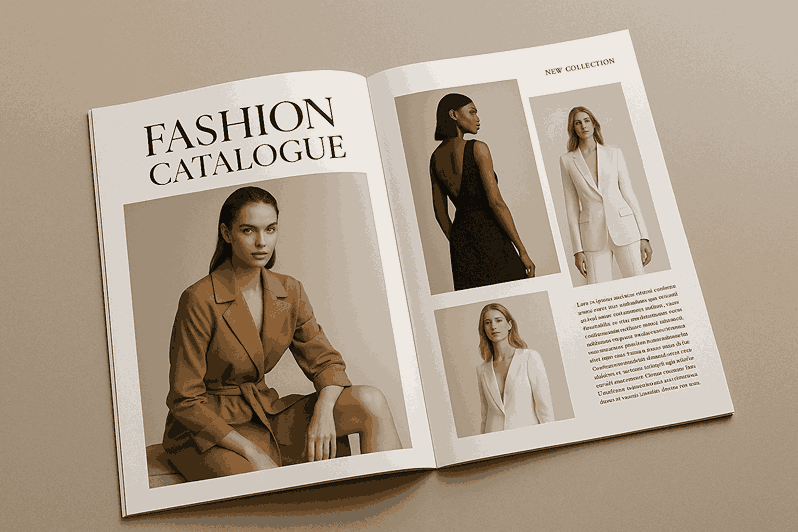
👗 Fashion & Apparel
✅ Editorial-style layouts
✅ Model based lifestyle shots
✅ Seasonal color flows
✅ Styled collections
Emotional branding dominates this sector’s CATALOGUE DESIGN.
🏭 Manufacturing & Industrial
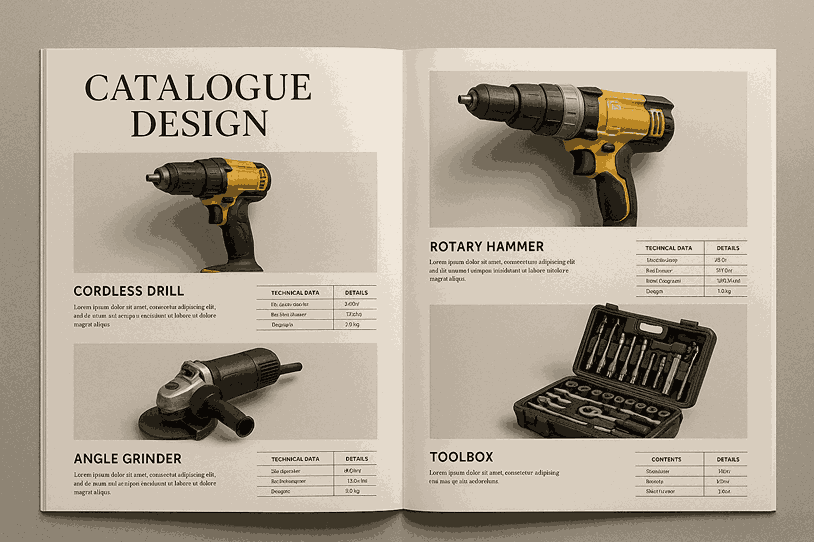
✅ Technical schematics
✅ Feature breakdown sections
✅ Safety certifications
✅ Comparison tables
Clarity and data presentation lead here.
🏥 Healthcare & Medical
✅ Clean white layouts
✅ Doctor endorsements
✅ Certification highlights
✅ Compliance documentation snippets
Trust signals outperform decorative visuals.
🏗️ Real Estate
✅ Floor plans
✅ 3D renders
✅ Amenity visuals
✅ Project timelines
✅ Investment benefit charts
Strong infographics enhance buying confidence.
Conversion Optimization in CATALOGUE DESIGN
Design alone doesn’t convert — strategy converts.
Here’s how high-performing catalogues are optimized:
✅ Clear Call-To-Action Placement
Bad example:
❌ CTA randomly hidden at last page
Good practice:
✅ Small CTAs every 2–3 pages
✅ QR codes near hero products
✅ Phone/email CTA strips at page footers
✅ Product Comparison Tables
Put comparison tables where buyers are:
- Comparing versions
- Evaluating price ranges
This reduces confusion and speeds decision-making.
✅ Price Transparency
Hidden pricing causes hesitation. Displaying:
- Starting prices
- Bulk discounts
- Package bundles
boosts trust and inquiry volume.
✅ Navigation Index
Include:
- Table of contents
- Section color coding
- Thumbnail navigation icons
Better navigation keeps readers engaged longer.
✅ Sales Funnel Integration
Modern CATALOGUE DESIGN integrates sales funnels directly:
Flow example:
View catalogue →
Scan QR →
WhatsApp inquiry →
Auto product PDF reply →
Sales call booking
That funnel produces qualified leads daily when executed correctly.
Printing Techniques That Enhance Catalogue Impact
Print quality affects brand visibility more than most realize.
⭐ Paper Selection
- 170–200 GSM glossy → fashion & hospitality
- 250–300 GSM matte → corporate branding
- Recycled Kraft paper → sustainability focus
⭐ Binding Methods
Choose based on durability:
- Saddle stitch (thin catalogues)
- Perfect binding (premium catalogues)
- Spiral binding (technical manuals)
⭐ Special Finishing
Premium finishes include:
✅ Spot UV coating
✅ Embossed logos
✅ Gold/silver foiling
✅ Soft-touch lamination
These transform ordinary catalogues into luxury brand assets.
Printing Cost Optimization Tips
High-quality CATALOGUE DESIGN need not burn budgets.
✅ Print in bulk quarterly instead of monthly
✅ Use limited interior ink coverage
✅ Print grayscale spec pages
✅ Regional distribution planning
Smart Cost Hack
Design core templates and update only product insert pages instead of redesigning full catalogues each season.
CATALOGUE DESIGN ROI: Measuring Real Business Impact
Don’t guess — measure.
Track:
✅ QR scan frequency
✅ Catalogue downloads
✅ Inquiry attribution source
✅ Sales team closing ratios from catalogue leads
Case Study Snapshot
A Pune solar equipment supplier tracked catalogue QR scans:
Before redesign:
5 inquiries/month
After professional CATALOGUE DESIGN:
64 inquiries/month — with a 32% close rate.
👉 Learn more about our branding solutions → Logo Designer India
✅ Refer to These Links For Better Understanding
SEO Writing Formula for High-Impact CATALOGUE DESIGN
Even the most visually stunning catalogue can fail if the content doesn’t connect with buyers.
That’s why top brands integrate SEO copywriting principles inside their CATALOGUE DESIGN process — especially for digital PDFs and website catalogues.
The 4-Step Description Formula
Use this structure for every product or service description:
✅ 1. Problem Identification
Address customer pain quickly:
“Tired of furniture that wears out within a year?”
✅ 2. Solution Introduction
Introduce product as the remedy:
“Our solid wood dining collection offers superior durability…”
✅ 3. Benefit + Feature Blend
Explain what makes it different:
“Crafted from sustainable teak with protective matte coating—ensuring elegance and resistance to scratches.”
✅ 4. Soft CTA
Nudge purchasing action:
“Available for quick dispatch. Scan for pricing updates.”
This formula results in high-readability catalogue listings that increase inquiries without sounding salesy.
How to Optimize Digital CATALOGUE DESIGN for SEO
Although PDFs are not traditional web pages, they are crawlable by Google. Optimizing your online catalogues improves discovery and rankings.
✅ SEO Best Practices
Include:
- Optimized filenames:
👉catalogue-design-furniture-2025.pdf - Proper meta titles inside PDF properties
- ALT text for images
- Internal links to website pages
- Text-based content (avoid image-only heavy OCR scans)
✅ Ideal Digital Catalogue Page Structure
Title Page:
“CATALOGUE DESIGN – Complete Product Collection 2025”
Introduction Page:
Brand overview with keyword placement
Product Pages:
SEO-structured product descriptions
FAQ Page:
Buyer objections answered
Final CTA:
Clickable sales funnel buttons
This structure enhances search visibility and improves reader conversions.
✅ Ultimate DIY CATALOGUE DESIGN Checklist
Before finalizing or approving your catalogue, review this professional-grade checklist:
Branding
✅ Logo correctly placed
✅ Color palette consistent
✅ Fonts standardized
Layout
✅ Balanced image-to-text ratio
✅ Grid structure maintained
✅ Sufficient white space
Visuals
✅ High-resolution images
✅ Real-life lifestyle shots included
✅ Consistent lighting tones
Content
✅ Benefit-focused descriptions
✅ Simple language
✅ No grammar or spelling errors
Navigation
✅ Table of contents
✅ Clear category dividers
✅ Page numbers
Conversion
✅ QR codes placed near products
✅ CTAs visible every few pages
✅ Sales contact icons clickable
SEO
✅ Keyword optimized titles
✅ ALT texts applied
✅ Downloadable versions indexed
Checking all of the above ensures your CATALOGUE DESIGN performs as a true marketing asset, not just a brochure.
When Should You Hire a Professional CATALOGUE DESIGN Agency?
DIY works for simple projects — but scaling businesses often benefit from specialist help.
✅ Hire Professionals When:
- Your catalogue exceeds 20+ pages
- You sell premium or technical products
- Brand consistency matters across campaigns
- Conversion results matter more than aesthetics alone
Professional designers bring:
- Buyer psychology expertise
- Print production knowledge
- Layout optimization tools
- Conversion testing methodologies
This elevated approach significantly outperforms amateur templates.
Brand Advantage: Why Businesses Trust Logo Designer India
At Logo Designer India, we specialize in strategic CATALOGUE DESIGN tailored for:
✅ Manufacturers
✅ Retail brands
✅ Doctors & healthcare centers
✅ Builders & real estate firms
✅ Interior designers
✅ Exporters & distributors
Our team integrates:
✔ Visual excellence
✔ SEO copywriting
✔ Print-ready production
✔ Digital sharing optimization
⭐ Our Catalogue Services Include:
- Cover concept creation
- Page grid structure planning
- Product photography coordination
- SEO-optimized descriptions
- QR lead-capture integration
- Print management support
Real Client Case Study
A medical equipment supplier needed a catalogue redesign for hospital outreach.
Before:
- No structured product flow
- Random font usage
- Old imagery
After Professional CATALOGUE DESIGN:
✅ Organized device categories
✅ Modern corporate layouts
✅ Professional image retouching
✅ QR-linked inquiry system
Results:
📊 68% increase in hospital inquiries
📊 41% improvement in sales closure ratio
Future of CATALOGUE DESIGN
What lies ahead?
🚀 AI-assisted personalization
🚀 Video-integrated digital catalogues
🚀 Dynamic pricing auto-updates
🚀 Augmented Reality product previews
🚀 Fully paperless interactive catalogs
Being early adopters of these changes ensures you stay market relevant in 2025 and beyond.
✅ Final Summary
To succeed with CATALOGUE DESIGN, your business must blend:
✔ Strategic layout
✔ Emotional storytelling
✔ SEO content writing
✔ Mobile-friendly formats
✔ Cost-efficient printing
✔ Conversion funnel integrations
Great catalogues:
- Educate buyers
- Strengthen brands
- Shorten sales cycles
- Multiply lead velocity
When your catalogue is optimized both visually and strategically, it becomes your most effective 24/7 silent salesperson.
📣 Call to Action (CTA)
Ready to elevate your CATALOGUE DESIGN and power your sales in 2025?
👉 Visit Logo Designer India
👉 Book a Free Consultation
Our team at Logo Designer India will help transform your simple product listing into a powerful brand showcase that attracts, converts, and sells.
❓ Frequently Asked Questions (FAQ) –
1. What is the average cost of professional CATALOGUE DESIGN in India?
Prices range between:
₹8,000 – ₹50,000+ depending on:
- Page count
- Photography needs
- Print readiness requirements
2. How long does it take to design a professional catalogue?
Typical timelines:
- 10–15 pages → 7–10 days
- 30+ pages → 2–3 weeks
3. Do digital catalogues perform better than printed ones?
Both have strengths:
✅ Digital → fast sharing & low cost
✅ Print → premium perception & offline browsing
Best results come from a hybrid CATALOGUE DESIGN strategy.
4. Can catalogue PDFs help improve website SEO?
Yes. When optimized with:
- SEO titles
- Internal links
- ALT tags
They contribute to online discoverability and lead generation.
5. What mistakes hurt catalogue conversions the most?
❌ Crowded layouts
❌ Low-quality images
❌ Over-technical descriptions
❌ Missing calls-to-action
❌ Poor navigation flow