Your logo is more than a symbol placed beside your business name. It is one of the first visual elements customers notice when they discover your business online or offline.
In 2026, businesses compete across websites, social media, e-commerce platforms, packaging, advertisements, marketplaces, and physical stores. Your visual identity needs to work across all these platforms while communicating what makes your business different.
This is where a professional logo designer can make a difference.
A well-designed logo does not simply make your business look attractive. It can establish a recognizable visual identity, support your positioning, and create consistency across different customer touchpoints.
Whether you are launching a startup, expanding an established company, or planning a complete rebrand, working with a professional logo designer can help you create an identity designed specifically around your business.
Why Great Logo Design Matters in 2026
Branding has become increasingly visual.
Customers can discover a company through an Instagram post, Google search, YouTube video, online marketplace, website, packaging, or digital advertisement.
Your logo may appear in all of these places.
That means modern businesses need more than a logo that looks good on a business card. They need an identity that remains recognizable across different sizes, screens, backgrounds, and applications.
A professional logo designer approaches this challenge by considering where and how your identity will be used.
A modern logo may need to work as:
- A website header
- A social media profile image
- A mobile icon
- A favicon
- A product label
- A packaging element
- A video watermark
- A storefront sign
- A business card
- An advertising graphic
The objective is to create an identity that can adapt without losing its core characteristics.
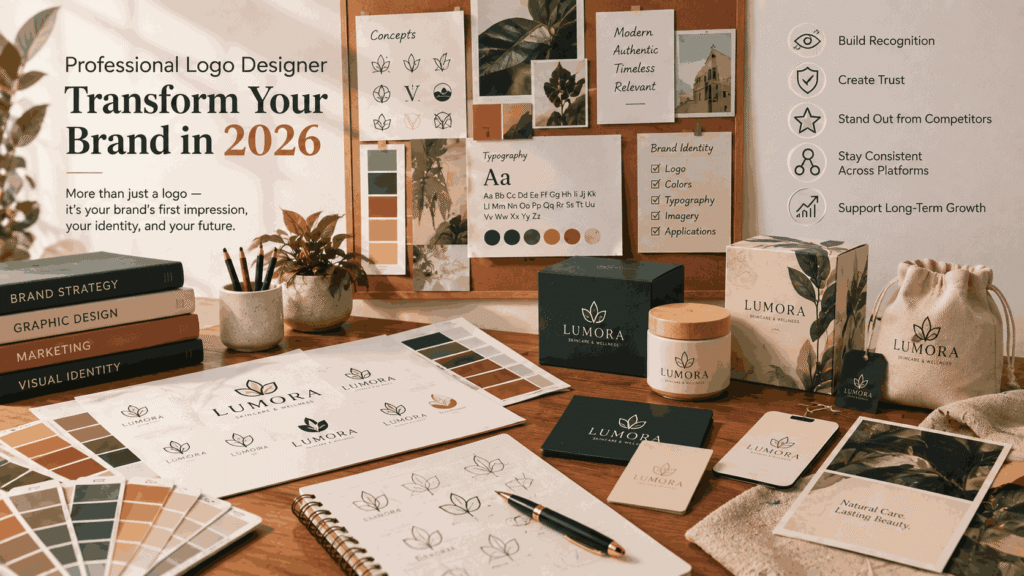
10 Amazing Ways Great Design Can Transform Your Brand
1. Create a Powerful First Impression
Your logo can influence the first visual impression customers have of your business.
Imagine someone discovers your company through Instagram. They see your profile picture, visit your website, browse your products, and look at your reviews.
Before they understand everything about your business, they have already experienced your visual identity.
A polished logo can contribute to a professional and organized brand presentation.
A professional logo designer can develop a visual identity that reflects your business personality instead of relying on generic templates.
This is particularly valuable for startups.
A new business may not yet have years of customer recognition behind it, so its visual presentation becomes an important part of its first interaction with potential customers.
2. Build a Distinctive Brand Identity
Your business needs to look like your business.
One of the limitations of template-based logo creation is that multiple companies can end up using similar symbols, fonts, and layouts.
This can make brands difficult to distinguish.
A professional logo designer develops concepts specifically around your business, audience, industry, and positioning.
The design could use:
- A custom wordmark
- Lettermark
- Monogram
- Abstract symbol
- Geometric design
- Combination mark
- Minimal icon
- Custom typography
The goal is not to make a logo unusual simply for the sake of being different.
The goal is to make the identity relevant and distinctive.
3. Make Your Business More Recognizable
Strong brands become easier to recognize through repeated visual exposure.
Customers might see your logo on social media today and on your packaging several weeks later.
They might encounter it again through an advertisement or email.
Each interaction creates another opportunity to connect the visual identity with your business.
A professional logo designer can create a recognizable mark that becomes part of this repeated brand experience.
The logo can then work alongside your colors, typography, photography, illustrations, packaging, and other visual elements.
Over time, consistency can make the overall brand easier for customers to identify.
4. Give Your Brand a Clear Personality
Every business has a personality.
Your company might want to communicate:
- Premium quality
- Innovation
- Reliability
- Creativity
- Energy
- Simplicity
- Friendliness
- Sophistication
- Tradition
Your logo should support that personality.
For example, an upscale fashion company may require refined typography and a sophisticated visual system.
A youth-focused streetwear brand could need something more expressive and contemporary.
A financial consultancy may prefer a structured and professional identity.
A professional logo designer considers these differences before deciding on typography, shapes, colors, and composition.
5. Help Your Business Stand Out From Competitors
Most industries are crowded.
Customers have numerous options when choosing restaurants, fashion brands, technology companies, agencies, consultants, retailers, and service providers.
Your logo cannot make competitors disappear, but it can give your business a distinctive visual presence.
Imagine that every competitor in a particular industry uses the same visual formula.
If all the logos use identical symbols and similar colors, customers may have difficulty remembering individual brands.
A professional logo designer can study the competitive landscape and identify opportunities for visual differentiation.
Competitor research is not about copying.
It is about understanding what already exists and creating an identity with its own character.
6. Create a Digital-First Brand Identity
Digital platforms have changed how logos are used.
A logo that looks excellent on a large desktop screen might become difficult to recognize when reduced to a small mobile icon.
This is why responsive logo design is important.
A professional logo designer can create different versions of an identity for different applications.
These may include:
- Primary logo
- Horizontal logo
- Stacked logo
- Compact logo
- Symbol or icon
- Monochrome version
- Social media version
- Favicon
Each version can maintain a connection with the primary identity while adapting to its environment.
This gives businesses greater flexibility across digital platforms.
7. Use Typography to Strengthen Your Identity
Typography is one of the most important components of logo design.
The typeface you choose can influence the personality of your brand.
Elegant serif typography can create a different impression from bold geometric sans-serif typography.
Rounded typography can feel different from sharp, angular lettering.
A professional logo designer considers:
- Font personality
- Letter spacing
- Weight
- Proportion
- Readability
- Alignment
- Scalability
- Customization
In some projects, designers may modify individual letters to create a more distinctive wordmark.
These details can make a significant difference between a generic logo and a carefully crafted identity.
8. Choose Colors With Purpose
Color is another important part of visual branding.
Businesses sometimes select colors simply because they personally like them.
However, effective brand color selection requires a wider perspective.
The palette needs to work with your:
- Target audience
- Industry
- Competitors
- Brand personality
- Website
- Packaging
- Advertising
- Social media
A professional logo designer can develop a color system that works across digital and physical applications.
The designer can also consider how the logo performs in monochrome, grayscale, and black-and-white situations.
A strong identity should not depend entirely on color to remain recognizable.
9. Create Consistency Across Your Marketing
Imagine visiting a company’s Instagram page and seeing one color palette.
You visit its website and find another.
Then you receive an advertisement using different typography.
Finally, you receive packaging with an unrelated logo.
The business may have good products, but its visual communication feels disconnected.
A cohesive brand identity solves this problem.
A professional logo designer can create the visual foundation that supports consistency across:
- Websites
- Social media
- Packaging
- Business cards
- Brochures
- Presentations
- Advertisements
- Signage
- Email communication
The logo becomes one recurring visual element that connects these experiences.
10. Build an Identity That Can Grow With Your Business
Your business today may look very different from your business five years from now.
You may introduce new products.
You may expand into new cities.
You may launch an online store.
You may enter international markets.
You may create new services.
Your identity should have enough flexibility to support this growth.
A professional logo designer can consider future applications before finalizing the visual direction.
This can reduce the likelihood of creating an identity that only works for your current situation.
The best branding decisions consider where the business is going, not just where it is today.
Professional Logo Designer vs DIY Logo Maker
DIY logo generators have made basic logo creation extremely accessible.
They can be useful for temporary projects, experiments, or personal initiatives.
However, template-based creation and strategic logo design are different approaches.
| DIY Logo Maker | Professional Logo Designer |
|---|---|
| Template-focused | Custom-focused |
| Fast creation | Research-driven process |
| Limited customization | Detailed customization |
| Generic visual options | Business-specific concepts |
| Basic file options | Professional file formats |
| Limited strategy | Brand positioning considered |
| Usually one design | Flexible logo system |
A professional logo designer can work beyond the visual mark itself and consider how the logo fits into the broader identity.
For a serious business, this broader perspective can be valuable.
What Does a Professional Logo Designer Consider?
Creating a successful identity requires understanding the business before beginning the visual work.
Target Audience
Who are your customers?
A logo designed for teenagers may require a completely different visual language from one designed for corporate decision-makers.
Industry
Your industry provides context.
Understanding common visual conventions can help a designer identify what customers expect while finding opportunities for differentiation.
Competitors
Competitor research helps identify crowded visual styles and potential similarities.
Your identity should establish its own visual space.
Brand Personality
Should your business look modern, premium, energetic, friendly, traditional, bold, or minimal?
The visual direction should support the intended personality.
Future Applications
Where will customers encounter the logo?
A restaurant may need menus, packaging, uniforms, delivery boxes, and signage.
A technology company may prioritize websites, applications, presentations, and digital advertising.
A fashion company may require labels, tags, packaging, social media assets, and campaign graphics.
These requirements can influence the design from the beginning.
The Professional Logo Designer Process
Understanding the design process helps businesses understand what goes into a custom identity.
Step 1: Brand Discovery
The process begins with understanding your company.
A designer may ask about your:
- Business goals
- Products
- Services
- Audience
- Competitors
- Brand personality
- Market positioning
This information creates the foundation for the project.
Step 2: Research
The designer examines the competitive environment and relevant visual styles.
The goal is to identify opportunities rather than simply reproduce existing trends.
Step 3: Creative Direction
Moodboards, typography references, color palettes, and visual examples can help establish a clear direction.
Step 4: Concept Development
The designer develops logo concepts based on the approved creative direction.
Each concept should have a purpose.
Step 5: Refinement
The selected concept is refined through feedback.
This can involve adjustments to:
- Typography
- Spacing
- Proportion
- Shapes
- Colors
- Alignment
Step 6: Final Delivery
The final identity is prepared in suitable formats.
Common deliverables can include:
- AI
- EPS
- SVG
- PNG
- JPG
Vector formats are especially useful because they can be scaled without losing quality.
How to Choose the Right Professional Logo Designer
Choosing a designer should involve more than looking at the cheapest quotation.
Review the Portfolio
Look for:
- Original concepts
- Strong typography
- Different visual styles
- Industry variety
- Real-world applications
- Attention to detail
A portfolio should demonstrate problem-solving ability rather than simply show attractive images.
Understand the Process
Ask how the designer approaches projects.
A structured process involving discovery, research, concept development, refinement, and final delivery can provide greater clarity.
Check the Deliverables
Before beginning, confirm exactly what you will receive.
Ask about:
- Number of concepts
- Revision rounds
- Source files
- Vector files
- Logo variations
- Brand guidelines
- Usage rights
Consider Communication
Good communication makes the design process easier.
The designer should understand your requirements and clearly communicate timelines, revisions, deliverables, and project expectations.
When Should You Hire a Professional Logo Designer?
You may want professional logo design if:
You are launching a new business
Starting with a cohesive identity can give your marketing a consistent visual foundation.
Your current logo looks outdated
An identity that once worked may no longer reflect your current business.
Your business has evolved
Your original logo may have been designed for a smaller company and no longer represent your current products or services.
Your logo does not work digitally
If your logo becomes unreadable on mobile devices or social media, it may need redesigning.
Your branding is inconsistent
Different logos, fonts, and colors across platforms can weaken visual consistency.
You are preparing for a rebrand
A rebrand is an opportunity to reconsider your positioning and visual identity together.
For reference: Medium
How Much Does Professional Logo Design Cost in 2026?
There is no single price for professional logo design.
The cost can vary depending on:
- Designer experience
- Project complexity
- Research requirements
- Number of concepts
- Revision rounds
- Brand strategy
- Logo variations
- File formats
- Brand guidelines
- Additional branding services
A basic logo and a complete visual identity are different services.
When comparing proposals, look beyond the headline price.
For example, one package might include one JPG file, while another might include multiple concepts, revisions, vector files, logo variations, color specifications, and brand guidelines.
Understanding the complete deliverables allows you to make a more informed comparison.
Common Logo Design Mistakes to Avoid
Using Too Many Elements
Adding more symbols does not automatically make a logo better.
Too many details can make it difficult to recognize at smaller sizes.
Copying Competitors
Competitor research is important, but your identity should remain original.
Choosing a Random Font
Typography should support your brand personality.
Designing Only for Social Media
Your logo may eventually appear on packaging, websites, signage, advertising, merchandise, and printed materials.
Following Every Trend
A logo should not depend entirely on short-lived visual trends.
Ignoring Black-and-White Applications
Your logo should remain usable when color is unavailable.
Focusing Only on Price
Consider the complete value of the project, including strategy, originality, revisions, file formats, and long-term usability.
Why Professional Logo Design Is a Long-Term Investment
A logo can remain part of your business identity for years.
That makes the initial design decision important.
Instead of asking only:
“What looks trendy in 2026?”
consider:
“Will this identity still represent my business as it grows?”
A professional logo designer can balance current design principles with the need for long-term relevance.
The objective is not to predict exactly what design will look like years from now.
It is to create a flexible identity that can evolve without losing its core recognition.
How Great Logo Design Supports Marketing
A strong visual identity can make marketing campaigns more cohesive.
Imagine launching a new product.
Your:
- Instagram campaign
- Website banner
- Digital advertisement
- Email campaign
- Product packaging
- Brochure
can all use the same visual language.
The logo becomes one of the recurring elements that connects these materials.
This can create a more organized and recognizable customer experience.
That is why logo design should be considered alongside broader branding and marketing activities.
Professional Logo Designer for Startups
Startups need to establish credibility while building recognition.
A new company may have excellent products but little existing brand awareness.
A professionally developed identity can provide a structured visual foundation from the beginning.
The logo can then be applied across:
- Websites
- Social media
- Pitch decks
- Packaging
- Presentations
- Digital advertisements
- Business cards
A scalable identity can also make future marketing easier.
Professional Logo Designer for Established Businesses
Established companies often approach logo design differently.
They may already have customer recognition but need an identity that reflects a changing business.
A company may have expanded its services, entered new markets, modernized its products, or changed its target audience.
In these situations, a professional logo designer can help evaluate whether the existing identity should be refined, modernized, or completely redesigned.
A successful rebrand does not necessarily mean changing everything.
Sometimes small strategic improvements can make the identity more contemporary while retaining familiar elements.
Frequently Asked Questions
What does a professional logo designer do?
A professional logo designer creates custom visual identities by considering a company’s audience, industry, positioning, personality, competitors, and future applications.
Why hire a professional logo designer instead of using a logo generator?
A logo generator generally provides template-based options. A professional designer can develop custom concepts and consider strategy, typography, color, scalability, differentiation, and broader brand applications.
How much does a professional logo designer charge?
Pricing varies depending on the designer, project scope, research, number of concepts, revisions, deliverables, and additional branding services.
How long does professional logo design take?
The timeline depends on the complexity of the project. A simple logo may require less time, while a complete brand identity involving research, concepts, revisions, and guidelines can take longer.
What should I receive from a professional logo designer?
Depending on the project, deliverables may include logo variations, vector files, raster files, color specifications, source files, and brand guidelines. Confirm the exact deliverables before starting.
Conclusion
Great design can transform the way your business presents itself.
Your logo may be a small visual element, but it can become one of the most recognizable parts of your brand.
In 2026, businesses need identities that can work across websites, social media, mobile screens, packaging, advertising, marketplaces, and physical spaces.
A professional logo designer can help turn your business idea into a distinctive visual identity built around creativity, strategy, consistency, and scalability.
Whether you are launching a startup, refreshing an established company, or preparing for a complete rebrand, investing in thoughtful logo design can give your business a stronger visual foundation.
Ready to transform your brand? Contact us for professional logo design and create a distinctive visual identity your customers can recognize, remember, and connect with.