
Introduction
Have you ever picked up a travel brochure, flipped through three pages, and put it right back down because it looked boring, cluttered, or outdated? You’re not alone. Studies show that travelers form an opinion about a tour package within the first 5-8 seconds of glancing at its catalogue. This is exactly why hiring the right International tour catalogue layout designer can make or break your travel business.
In today’s competitive tourism industry, your catalogue is often the very first “handshake” between your brand and a potential traveler. A poorly designed layout can push customers straight to your competitor, while a professionally crafted one can turn a casual browser into a confirmed booking. That’s the power a skilled International tour catalogue layout designer brings to the table.
In this comprehensive guide, we’ll walk you through everything you need to know from what makes a catalogue design successful, to real-world examples, statistics, budgets, the design process, common mistakes, and how to choose the right designer for your travel brand.
Why Your Travel Business Needs a Professional International Tour Catalogue Layout Designer
Travel is an emotional purchase. People aren’t just buying flights and hotel stays they’re buying an experience, a memory, a story. This is where a talented International tour catalogue layout designer becomes indispensable.
A generic, poorly structured catalogue fails to communicate the emotion behind a destination. On the other hand, a well-designed one:
- Builds instant trust and credibility
- Highlights your USP (unique selling proposition)
- Makes complex itineraries easy to understand
- Encourages faster decision-making
- Increases the perceived value of your tour packages
The Psychology Behind Great Catalogue Design
Human brains process visuals 60,000 times faster than text. This means the layout, color scheme, imagery, and typography chosen by your International tour catalogue layout designer directly influence how quickly and positively a customer reacts to your offering.
A cluttered layout creates confusion and hesitation. A clean, well-structured one creates confidence and confidence leads to conversions.
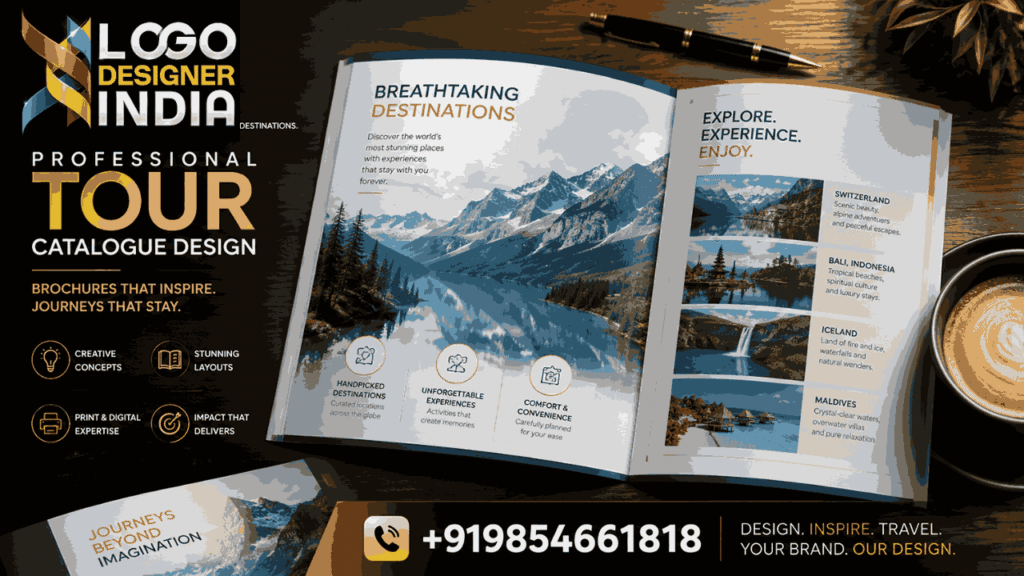
What Does an International Tour Catalogue Layout Designer Actually Do?
Many travel agencies assume catalogue design is just “putting pictures and text together.” In reality, a professional International tour catalogue layout designer handles a lot more than that.
Core Responsibilities
- Understanding the target audience — luxury travelers, backpackers, families, or corporate groups all need different visual language.
- Structuring content hierarchy — deciding what information appears first, second, and last.
- Selecting typography and color palettes that reflect your brand identity.
- Curating and placing high-quality imagery of destinations, hotels, and experiences.
- Designing itinerary grids, maps, and pricing tables that are easy to scan.
- Ensuring print and digital compatibility — a catalogue often needs to work as both a PDF and a printed booklet.
- Maintaining brand consistency across every page.
An experienced International tour catalogue layout designer doesn’t just make things “look nice” they design with strategy, ensuring every page nudges the reader closer to booking.
Key Elements of a Winning Tour Catalogue Layout
If you’re evaluating an International tour catalogue layout designer, here are the non-negotiable elements they should nail.
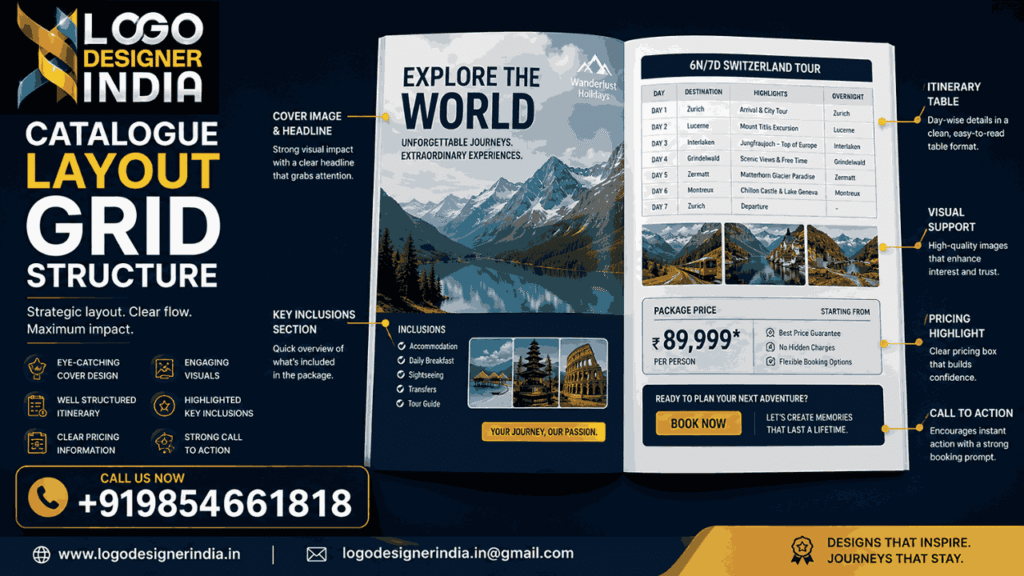
1. A Powerful Cover Page
The cover is your first impression. It should feature a striking hero image, your logo, and a tagline that instantly communicates the type of travel experience you offer.
2. Clear Visual Hierarchy
Readers should be able to scan a page in seconds and understand:
- Where the destination is
- What’s included
- How much it costs
- How to book
3. Consistent Grid System
A professional International tour catalogue layout designer always works with a grid system. This keeps spacing, image sizes, and text blocks aligned across every single page, giving the catalogue a polished, premium feel.
4. High-Quality, Relevant Imagery
Stock photos that feel generic can hurt credibility. The best catalogues use authentic destination photography, real traveler experiences, and vibrant, high-resolution images.
5. Easy-to-Read Itinerary Tables
Day-wise itineraries should be broken into simple tables or timeline graphics rather than dense paragraphs.
6. Strategic Use of White Space
White space isn’t wasted space — it improves readability and gives the design room to breathe.
7. Strong Call-to-Action on Every Page
Every spread should gently guide the reader toward the next step a QR code, a contact number, or a “Book Now” button.
Real-World Example: How a Redesigned Catalogue Increased Bookings
Let’s look at a relatable scenario. A mid-sized travel agency offering Europe tour packages was struggling with low conversion rates, despite running heavy social media ads. Their catalogue was text-heavy, used low-resolution images, and had no consistent color theme.
After hiring a professional International tour catalogue layout designer, the agency:
- Reduced text by 40% and replaced it with visual itinerary timelines
- Introduced a consistent color palette matching their brand
- Added authentic traveler photos instead of stock images
- Reorganized pricing into an easy comparison table
Within three months of distributing the redesigned catalogue at travel fairs and via email campaigns, the agency reported a 32% increase in inquiry-to-booking conversion. This is a common trend across the tourism industry small design changes, executed strategically, lead to measurable business impact.
Industry Statistics That Prove Design Matters
Nearly 94% of first impressions are design-related, a finding well documented by design authorities like Forbes, which highlights how captivating visuals across a brand’s website, packaging, and marketing materials strengthen impact during a customer’s very first encounter with a business.
- Brochures and catalogues with strong visual hierarchy see up to 80% higher engagement than text-heavy alternatives.
- Businesses that invest in professional design report brand recognition increases of up to 33%, a trend echoed by branding studies.
These numbers highlight why hiring a specialized International tour catalogue layout designer, rather than relying on generic templates, is a smart long-term investment.
The Step-by-Step Process a Professional International Tour Catalogue Layout Designer Follows
Understanding the design process helps you set realistic expectations and collaborate more effectively with your designer. Here’s how most experienced professionals approach a catalogue project from start to finish.
Step 1: Discovery and Brief Collection
Before opening any design software, a skilled International tour catalogue layout designer starts by understanding your brand, audience, and objectives. This includes reviewing your existing branding, target markets, competitor catalogues, and the specific destinations or packages you want to feature.
Step 2: Content Audit and Organization
Next, the designer collects and organizes all raw content — itineraries, pricing, images, testimonials, and terms & conditions. This step is crucial because messy or incomplete content is one of the biggest causes of project delays.
Step 3: Wireframing and Layout Planning
Before adding final visuals, the designer sketches a wireframe or low-fidelity layout for each page. This establishes where headlines, images, itinerary tables, and CTAs will sit, ensuring a logical flow from cover to back page.
Step 4: Visual Design and Branding Application
This is where color palettes, typography, iconography, and imagery come together. A professional International tour catalogue layout designer applies your brand guidelines consistently, so every page feels like part of the same cohesive story.
Step 5: Review, Feedback, and Revisions
Most agencies build in two to three rounds of revisions. This is your opportunity to request changes to layout, wording placement, or image choices before the design is finalized.
Step 6: Print-Ready and Digital File Preparation
Finally, the designer exports print-ready files (with correct bleed, resolution, and color mode) alongside optimized digital versions for websites, email, and social sharing.
How Much Does an International Tour Catalogue Layout Designer Cost?
Budget is often the first question travel businesses ask, and rightly so. While exact pricing varies by agency, project scope, and region, here’s a general breakdown to help you plan.
Factors That Influence Pricing
- Number of pages — a 12-page catalogue costs significantly less than a 50-page one.
- Level of customization — fully custom illustrations and icons cost more than template-based layouts.
- Print vs. digital-only — print-ready files often require additional prepress work.
- Number of revision rounds — unlimited revisions typically come at a premium.
- Turnaround time — rush projects usually carry an urgency fee.
Getting the Best Value
Rather than choosing the cheapest option, focus on the value a professional International tour catalogue layout designer delivers in terms of increased bookings, brand credibility, and reusability of design assets across future campaigns. A well-designed catalogue template can often be reused and updated season after season, making it a long-term investment rather than a one-time expense.
Print Production Considerations Every Travel Business Should Know
If your catalogue will be printed for travel fairs, agent distribution, or in-store display, there are technical details your International tour catalogue layout designer must handle correctly.
1. Bleed and Trim Margins
Images and background colors that reach the edge of a page need extra “bleed” area to avoid white borders after trimming.
2. CMYK Color Mode
Unlike digital screens that use RGB, printed materials require CMYK color conversion to ensure colors appear accurately on paper.
3. Paper Stock and Finish
Glossy finishes make images pop, while matte finishes feel premium and reduce glare — the right choice depends on your brand positioning.
4. Binding Style
Saddle-stitch binding works well for shorter catalogues, while perfect binding suits thicker, premium travel guides.
A designer experienced in both print and digital formats ensures your catalogue looks flawless no matter where it’s viewed.
DIY Templates vs. Hiring a Professional International Tour Catalogue Layout Designer
Many travel businesses start with free templates from design tools. While tempting, this approach has limitations.
DIY Template Limitations
- Generic layouts that look similar to competitors
- Limited customization for complex itineraries
- Inconsistent branding across pages
- Poor print-readiness (bleed, resolution, CMYK issues)
Benefits of Hiring a Professional
- Fully customized layout aligned with your brand
- Expertise in both print and digital formats
- Strategic content placement for higher conversions
- Ongoing support for seasonal or regional catalogue updates
A skilled International tour catalogue layout designer essentially pays for themselves by increasing the effectiveness of every catalogue you distribute — whether at travel expos, through agents, or via digital downloads.
Common Mistakes Travel Businesses Make With Catalogue Design
1. Overloading Pages With Text
Travelers want to feel inspired, not read an essay. Break content into short, digestible chunks.
2. Ignoring Mobile/Digital Formats
Many travelers browse catalogues on tablets or phones. Your International tour catalogue layout designer must design with responsive PDF and digital flipbook formats in mind.
3. Inconsistent Branding
Switching fonts, colors, or logo placement between pages confuses readers and looks unprofessional.
4. Low-Resolution Images
Blurry or pixelated destination photos instantly reduce trust.
5. No Clear Pricing Structure
Hidden or confusing pricing information leads to drop-offs. Use simple, transparent tables.
6. Forgetting Cultural Sensitivity for International Audiences
Since these catalogues often target travelers from multiple countries, imagery, colors, and even layout direction (left-to-right vs. right-to-left reading patterns) should be considered when relevant.
Cultural and Regional Considerations for International Catalogues
Because the focus here is specifically on an International tour catalogue layout designer, it’s worth highlighting why cross-cultural design awareness matters.
Color Symbolism Varies by Region
Colors that feel luxurious in one culture may carry entirely different connotations elsewhere. A thoughtful designer researches your target markets before finalizing a palette.
Language and Localization
If your catalogue will be translated into multiple languages, layouts need flexible text boxes since word lengths vary significantly between languages like English, Arabic, or Mandarin.
Imagery That Resonates Globally
Featuring diverse traveler demographics in your photography helps international audiences see themselves enjoying your tour packages, increasing relatability and trust.
How Catalogue Design Supports Your Broader Marketing and SEO Goals
A catalogue isn’t just a standalone document — it plays a role in your overall digital marketing funnel too.
Repurposing Catalogue Content for Your Website
Sections of your catalogue, such as destination highlights or itinerary breakdowns, can be repurposed into blog posts, landing pages, or social media carousels, extending the value of your International tour catalogue layout designer‘s work.
Digital Catalogues Improve On-Site Engagement
Embedding an interactive digital catalogue on your website can increase average session duration, which indirectly supports your site’s SEO performance.
Consistent Branding Strengthens Search Presence
When your catalogue, website, and social media all share consistent visual branding, it reinforces brand recall — making users more likely to search for your business by name.
How to Choose the Right International Tour Catalogue Layout Designer
1. Review Their Portfolio
Look specifically for travel, tourism, or hospitality catalogue projects — not just general graphic design work.
2. Check Print + Digital Expertise
Your designer should be comfortable creating both press-ready print files and interactive digital PDFs.
3. Ask About Their Design Process
A professional International tour catalogue layout designer should be able to explain how they approach content structuring, grid systems, and brand alignment.
4. Look for Industry Experience
Someone familiar with international tourism trends will understand seasonal packages, visa information layouts, and multi-country itineraries.
5. Evaluate Communication and Turnaround Time
Catalogue design often has tight deadlines around travel seasons and expos, so reliability matters just as much as creativity.
Curious where to begin? Explore our services and discover the right solution for your brand and Dive deeper into our portfolio page to understand the thought process that goes into every project.
Quick Checklist Before You Hire a Designer
Use this simple checklist to evaluate any International tour catalogue layout designer before signing off on a project:
- ✅ Do they have relevant travel/tourism portfolio samples?
- ✅ Can they deliver both print-ready and digital formats?
- ✅ Do they offer a clear revision policy?
- ✅ Is their pricing transparent, with no hidden costs?
- ✅ Do they understand your target audience and regions?
- ✅ Can they work within your timeline for upcoming travel seasons?
2026 Design Trends for International Tour Catalogues
1. Minimalist Layouts With Bold Typography
Clean designs with striking headlines are replacing cluttered, text-heavy pages.
2. QR Code Integration
Linking printed catalogues to digital booking pages or video previews of destinations.
3. Sustainable Travel Highlights
Catalogues increasingly dedicate sections to eco-friendly and responsible tourism options.
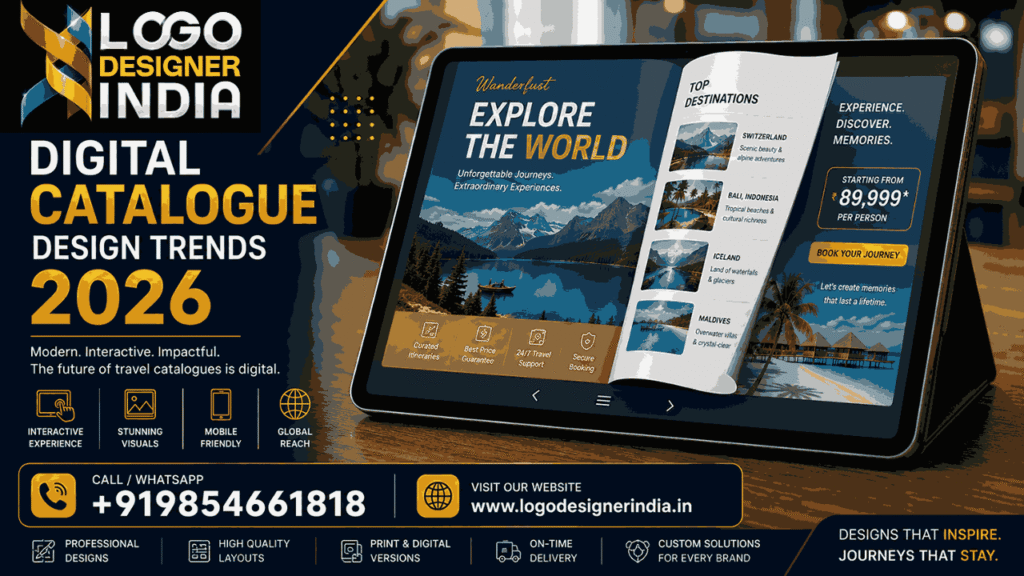
4. Interactive Digital Flipbooks
Beyond static PDFs, many agencies now offer scrollable, animated digital catalogues.
5. Localized Content Blocks
Catalogues tailored for different regions or languages, designed by an experienced International tour catalogue layout designer who understands cross-cultural design nuances.
Conclusion- Partner With a Trusted International Tour Catalogue Layout Designer
Your tour catalogue is more than just a marketing document — it’s a reflection of your brand’s credibility, professionalism, and the experiences you promise travelers. Investing in a skilled International tour catalogue layout designer ensures your catalogue doesn’t just inform, but genuinely inspires action.
At Logo Designer India, we specialize in creating stunning, conversion-focused catalogue designs tailored specifically for travel and tourism businesses. From cover to closing page, our team understands how to blend creativity with strategy to help your brand stand out in a crowded market.
Ready to turn casual browsers into confirmed bookings?
Logo Designer India crafts stunning, conversion-focused tour catalogues built for the international travel market.
Reach out at 9854661818 or visit logodesignerindia.in — let’s design a catalogue your customers can’t put down.
Frequently Asked Questions (FAQs)
Q1: What does an International tour catalogue layout designer charge on average?
Pricing varies based on catalogue length, complexity, and customization, but most professional designers offer package-based pricing depending on the number of pages and revisions required.
Q2: How long does it take to design a complete tour catalogue?
On average, a detailed catalogue with 15-30 pages can take anywhere from 2 to 4 weeks, depending on content readiness and revision cycles.
Q3: Can an International tour catalogue layout designer create both print and digital versions?
Yes, most professional designers create catalogues that work seamlessly as both print-ready PDFs and interactive digital flipbooks for websites and email campaigns.
Q4: Do I need to provide my own images, or can the designer source them?
It depends on the agency. Some International tour catalogue layout designers can source high-quality stock or curated destination images, while others prefer working with your original photography for authenticity.
Q5: Why should I hire a specialized designer instead of using a template?
Templates often look generic and aren’t tailored to your itineraries or brand identity. A specialized International tour catalogue layout designer creates a custom design strategy that improves readability, brand recall, and ultimately, bookings.
Q6: How many revisions are typically included in a catalogue design project?
Most professional designers include 2-3 rounds of revisions in their standard packages, with additional rounds available at extra cost if needed.
Q7: Can a catalogue designer help with multi-language or multi-country catalogues?
Yes, an experienced International tour catalogue layout designer builds flexible layouts that accommodate translated text and region-specific imagery without breaking the design.